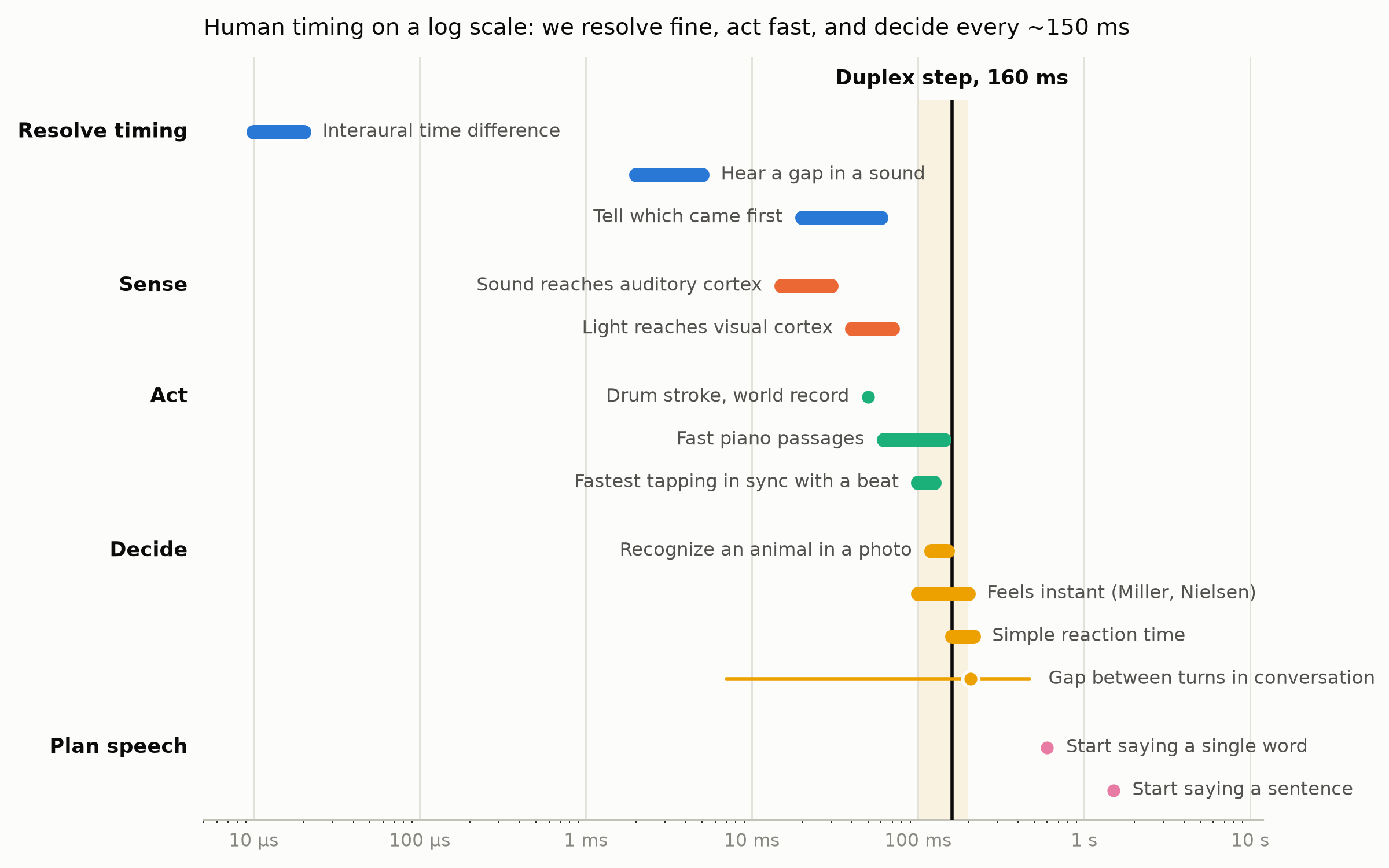
Pick any place where machines meet people and you will find a number between 100 and 200 ms. In 2009 Jake Brutlag at Google added artificial delays to search results: 50 ms made no measurable difference, 100 ms already cost 0.2% of searches per user, 400 ms cost 0.6%, and the damage lingered for weeks after the delay was removed. Robert Miller argued in 1968 that the response to a keypress should take no more than 0.1 to 0.2 seconds, and Jakob Nielsen’s rule of thumb is that 0.1 s feels instantaneous. Google’s Core Web Vitals call a page interaction good if it responds within 200 ms. Google’s ad exchange gives bidders as little as 80 ms to answer an auction. And in conversation, the average gap between one person stopping and the next one starting is about 200 ms.
When we designed Higgs Realtime Duplex, one of the first numbers we had to pick was how often the model gets to look at the world and decide what to do next. We picked 160 ms. Is that just another round number, or is there something behind it? The tempting explanation is that 150 ms is simply how long a signal takes to get from your eyes and ears to your brain. It isn’t.
It isn’t how fast we sense
Light reaches the primary visual cortex 40 to 70 ms after it hits the retina. Sound is faster still: about 6 ms to the brainstem and 15 to 30 ms to the primary auditory cortex. If 150 ms were the cost of getting the signal in, we would be done long before.
It isn’t how finely we resolve time
We can tell which of two events came first when they are about 20 ms apart, hear a silent gap of a few milliseconds in a sound, and locate a sound source from arrival-time differences of 10 to 20 microseconds between the two ears. The brain’s clock is fine-grained. What is long is the latency, and latency and resolution are different things, as anyone who has watched a 4K video over a bad connection knows.
It isn’t how fast we act
The world record for drumming is 1,208 single strokes in a minute, 20 per second, one every 50 ms. Skilled pianists play passages with notes 60 to 140 ms apart, and people can tap along with a beat down to about 100 to 125 ms per tap. None of these notes is decided individually. The interval between them is shorter than the time it takes to notice a mistake and correct it, which was Karl Lashley’s argument in 1951: fast sequences are planned as a whole and then executed open loop. The drummer decides once and plays twenty notes.
It’s how fast we decide
Thorpe, Fize and Marlot showed people photos for 20 ms and asked whether there was an animal in them. The brain’s response separated the two cases about 150 ms after the image appeared. The fastest eye movements toward the right photo start after about 120 ms, and the average simple reaction time to a light is about 210 ms, with sound 30 to 50 ms faster. That is where the number lives: the time to take in a situation, decide something about it, and start acting.
It also explains why interfaces live at this scale. Every click, search and page update is one perceive-and-decide cycle. Albert Michotte found in his launching experiments that once the response lags by more than roughly 100 to 200 ms, we stop seeing it as a consequence of our action at all.
Conversation is the extreme case
Across ten languages, the gap between turns averages 208 ms, from 7 ms in Japanese to 469 ms in Danish, and the most common gap is zero. Yet it takes about 600 ms to start saying a single word, and about 1.5 seconds to start a sentence. The arithmetic only works if listeners plan their reply while the other person is still talking, predicting when the turn will end. People decide slowly, in the background, and commit fast when the moment comes.
What this means for a model
Duplex works the same way. Every 160 ms step is a decision: speak, keep talking, stay quiet, say “mm-hm”, yield, or interrupt. Within a step it acts like the drummer, with two audio frames and two face latents going out without deciding again. Anything slower than a step, such as reasoning, tool calls or handing a problem to the much larger backend model, spans many steps and runs in the background while the conversation continues. That was the subject of the previous post.
We aren’t the only ones to land here. Moshi uses 80 ms frames with a theoretical latency of 160 ms, SyncLLM uses chunks of 160 to 240 ms, and Thinking Machines uses 200 ms micro-turns.
The cost of a faster clock
Why not decide more often? Because every step costs a forward pass. Halving the step doubles the number of passes, shrinks the batches, and leaves the GPU spending more of its time on overhead. The Moshi authors cut their frame rate from 100 Hz to 12.5 Hz because “generating 100 tokens per second is incompatible with streaming inference”. Going the other way doesn’t work either: at 400 ms per step the model would decide later than people expect in a turn gap of about 200 ms.
So 160 ms is roughly the coarsest step that still keeps up with human turn-taking. That is what lets us hit our cost target, an hour of model time for at most a tenth of an hour of a person’s time, with a 45B front model.
People don’t decide more often than about six times a second, and neither does our model. Everything else happens either within a step, fast and planned ahead, or across many steps, slowly and in the background.